 Natalie Sullivan
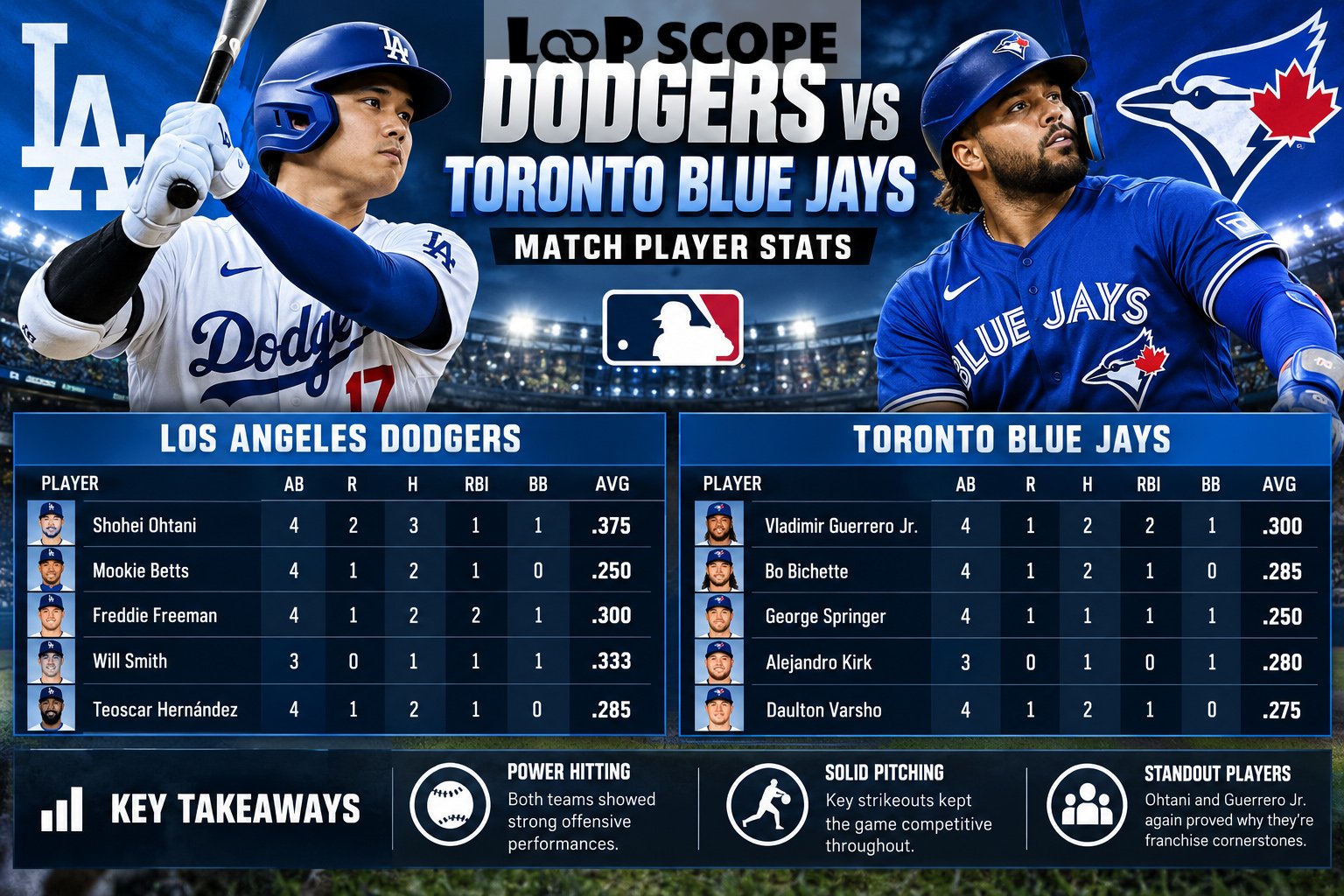
If you are searching for Dodgers vs Toronto Blue Jays match player stats, the most recent games between these teams came in early April 2026, when Los Angeles visited Rogers Centre for a three-game series. The Dodgers won the first two games, 14-2 and 4-1, and Toronto took the finale 4-3 to avoid a sweep.
This guide walks through all three box scores, highlights the best hitters and pitchers, and explains how to read the numbers. It also covers what has happened to both teams since, so you know how much those April stat lines still matter.
Quick Answer: Who Had the Best Stats in the Series?
Dodgers catcher Dalton Rushing had the single best individual line, going 4 for 4 with two home runs and two RBI in Game 1. Teoscar Hernandez drove in four runs that night, and Freddie Freeman added three RBI and a homer. In Game 2, Yoshinobu Yamamoto earned the win. In Game 3, Shohei Ohtani pitched six innings and allowed one run, while Toronto’s Tyler Rogers got the win in relief.
Game 1: Dodgers 14, Blue Jays 2
This was a blowout. The Dodgers collected 17 hits, five home runs, and 13 RBI, and Toronto used six pitchers who allowed 14 runs and 17 hits. Los Angeles starter Justin Wrobleski went five innings, allowed two hits and one run, walked four, and struck out two.
| Dodgers Hitter | AB | R | H | HR | RBI |
|---|---|---|---|---|---|
| Dalton Rushing | 4 | 3 | 4 | 2 | 2 |
| Teoscar Hernandez | 5 | 2 | 2 | 1 | 4 |
| Freddie Freeman | 4 | 2 | 2 | 1 | 3 |
| Shohei Ohtani | 6 | 2 | 2 | 1 | 1 |
| Kyle Tucker | 3 | 3 | 1 | 0 | 1 |
| Andy Pages | 4 | 0 | 2 | 0 | 2 |
| Hyeseong Kim | 4 | 1 | 2 | 0 | 0 |
| Max Muncy | 6 | 1 | 2 | 0 | 0 |
Rushing’s day is the one to remember. A four-hit game with two homers is rare for any hitter. Kyle Tucker scored three runs while collecting only one hit, a reminder that walks and patience produce value too. Tucker drew two walks.
For Toronto, the offense managed five hits, no home runs, and two RBI. Kazuma Okamoto had two hits, Ernie Clement had one hit and an RBI, and Andres Gimenez drove in a run. On the mound, Max Scherzer lasted two innings, allowing two runs, and Josh Fleming and Tommy Nance each gave up four runs.
Game 2: Dodgers 4, Blue Jays 1
The second game was a tighter pitching contest. Los Angeles scored twice in the third inning, once in the fifth, and once in the ninth. Toronto’s only run came in the sixth. The Dodgers had eight hits and the Blue Jays had six, with Toronto committing two errors.
Yamamoto got the win, Kevin Gausman took the loss, and Edwin Diaz picked up the save. A game like this shows why a pitching line matters more than a headline score, since the margin came from a few well-timed hits and clean defense. The attendance was 40,971 at Rogers Centre.
The Blue Jays snapped a six-game losing streak, while the Dodgers lost for the first time in six games. It was also the first time in seven games that Los Angeles was beaten after leading through six innings. Ben Casparius took the loss.
What the April Series Taught Us
The first lesson is about variance. A 14-2 game and a 4-3 game can happen in the same series, so a single score tells you little. The second is that depth matters: Rushing, Pages, and Kim produced from lower spots in the lineup. The third is that defense can change a game, as Toronto’s winning run came from a throwing error rather than a hit.
If you compare these box scores with the Dodgers’ game against the Padres, you can see how the same lineup performs against different pitching styles.
Key Players to Watch in Future Dodgers vs Blue Jays Games
Shohei Ohtani is the first name on any Dodgers stat sheet. He can affect the game as a hitter and a pitcher, so check both lines. Freeman and Tucker provide on-base skills, Muncy adds power, and Smith is a steady catcher. On the mound, Yamamoto is the ace to watch.
For Toronto, Vladimir Guerrero Jr. is the middle-of-the-order bat, with Springer, Okamoto, and Varsho behind him. Rogers and Hoffman are the late-inning arms, and Scherzer is the veteran starter.
| Team | Player | Stat Lines Worth Checking |
|---|---|---|
| Dodgers | Shohei Ohtani | Home runs, innings pitched, strikeouts |
| Dodgers | Freddie Freeman | On-base percentage, RBI |
| Dodgers | Yoshinobu Yamamoto | Strikeouts, walks, innings |
| Dodgers | Will Smith | Batting average, throwing out runners |
| Blue Jays | Vladimir Guerrero Jr. | Home runs, OPS |
| Blue Jays | George Springer | Extra-base hits, clutch RBI |
| Blue Jays | Tyler Rogers | Ground-ball outs, high-leverage innings |
| Blue Jays | Jeff Hoffman | Saves, home runs allowed |
Where Both Teams Stand Now
The Blue Jays had a difficult season. They were eliminated from playoff contention on September 23 after a loss in Baltimore, finishing 4.5 games behind the final AL wild card spot with four games left. Guerrero hit far fewer home runs than in 2025, and Springer and Scherzer did not repeat their strong 2025 performances.
The Dodgers did make the postseason, but they were swept by the Milwaukee Brewers in the National League Championship Series. That means neither team will play for the title this fall, and any new Dodgers vs Blue Jays meeting will have to wait until the next regular season.
Advanced Stats Worth Knowing
On-base plus slugging, or OPS, combines how often a hitter reaches base with how much power he has. Earned run average shows how many earned runs a pitcher allows per nine innings, and WHIP shows how many baserunners he allows per inning. For a quick comparison, a hitter’s OPS and a pitcher’s WHIP tell you more than batting average or win-loss record. You can look up those numbers and full game logs on Baseball Reference.
How to Pick the Real Top Performer
Start with run production, then context. A hitter with four hits and two homers in a blowout, like Rushing, had a great day, but a hitter with a go-ahead RBI in a one-run game may matter more. For pitchers, innings and runs allowed matter more than strikeouts alone. Finally, remember that defense and baserunning are part of the story, as Game 3 showed.
Common Mistakes When Reading Dodgers vs Blue Jays Stats
The first is treating RBI as a pure measure of skill, since it depends on who is on base. The second is judging a pitcher by one start. Third, fans often ignore defense, even though a single throwing error decided Game 3. Fourth, be careful with sources, since official scoring can change after a game.
Conclusion
Reading Dodgers vs Toronto Blue Jays match player stats means looking at the April series in context. Los Angeles won two of three, led by Rushing, Hernandez, Freeman, Yamamoto, and Ohtani, while Toronto showed resilience in the finale. Both teams have since gone in different directions, but the box scores remain a useful snapshot.
When these teams meet again, check the starting pitchers first, then the top of each lineup, then the bullpens. That order will tell you who really won the game.
Frequently Asked Questions
Who won the Dodgers vs Blue Jays series in April 2026?
The Dodgers won two of three games, winning 14-2 and 4-1 before losing 4-3.
Who had the best game in the series?
Dalton Rushing went 4 for 4 with two home runs and two RBI in Game 1.
How did Shohei Ohtani do in Game 3?
Ohtani pitched six innings and allowed one run on four hits, but he went 0 for 3 at the plate.
Who got the win in Game 3?
Toronto’s Tyler Rogers got the win, and Jeff Hoffman earned the save.
Did the Blue Jays make the playoffs in 2026?
No. Toronto was eliminated from contention on September 23.
What happened to the Dodgers in the 2026 postseason?
Los Angeles was swept by Milwaukee in the NLCS.
Where can I find official Dodgers vs Blue Jays player stats?
MLB.com and Baseball Reference publish official box scores for every game.