 Natalie Sullivan
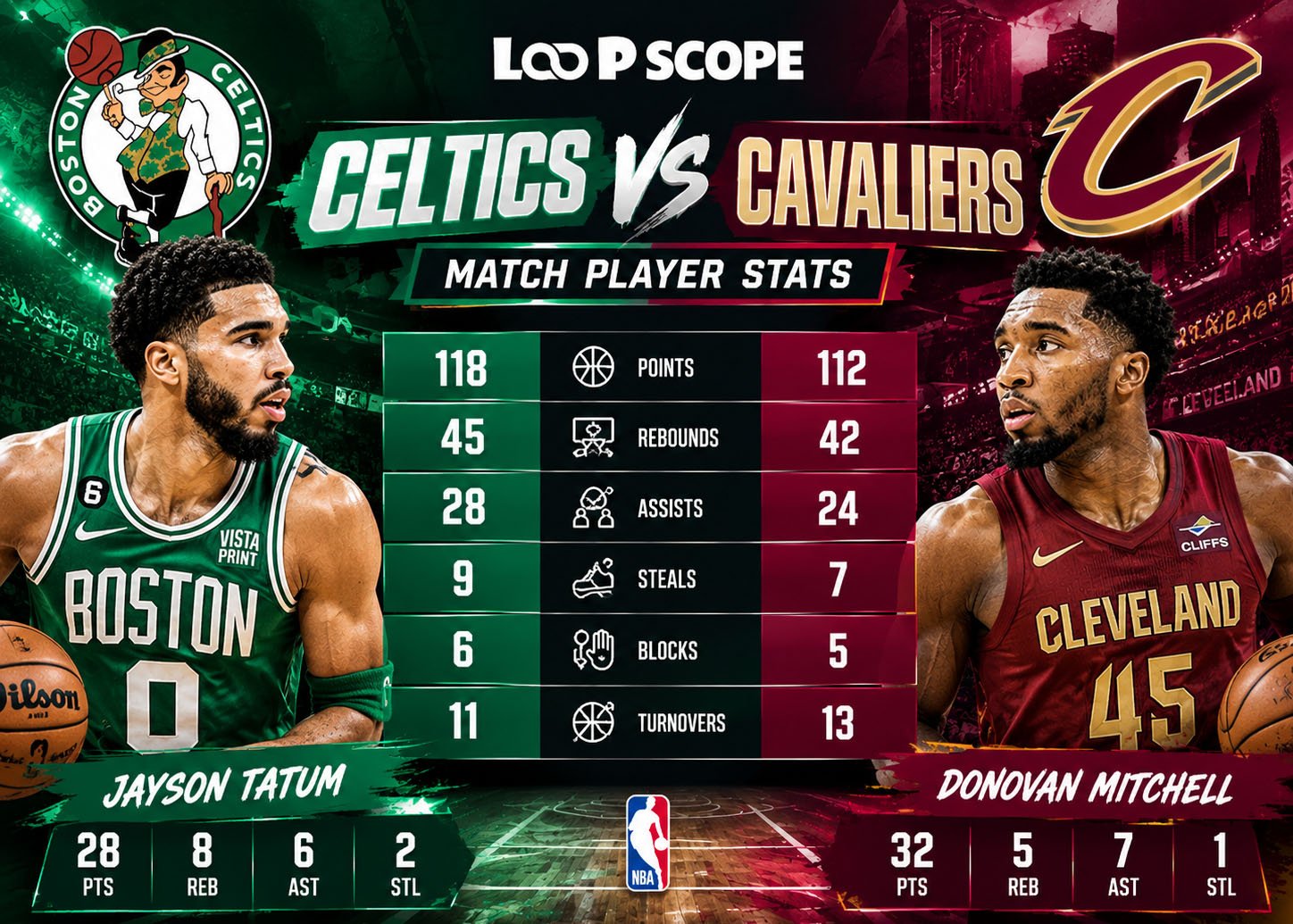
Anyone searching for Celtics vs Cleveland Cavaliers match player stats is usually trying to separate what a team did from how it did it. A final score may say Boston won, but the player numbers show whether Jayson Tatum carried the offense, whether Cleveland’s big men controlled the glass, or whether a bench player quietly changed the game.
This season there is an extra reason to look closely. Boston’s roster looks very different from the one fans knew for years, and Cleveland is trying to build on a strong run. That means familiar names are playing unfamiliar roles, and the box score is the clearest way to see how those changes are working.
What Celtics vs Cavaliers Player Stats Actually Measure
Player stats are a record of what each athlete produced while on the court: scoring, rebounding, passing, shooting efficiency, ball security, and defensive events like steals and blocks. In a game between two Eastern Conference contenders, those numbers help you answer practical questions. Who took the most important shots? Who defended the best opponent? Who protected the ball when pressure rose?
The danger is reading any one number alone. A 30-point night means something very different on 11-of-18 shooting than on 11-of-30. That is why good analysis of Celtics and Cavs stats weighs volume, efficiency, and impact together.
Quick Answer: How Do You Read a Celtics vs Cavaliers Box Score?
Check minutes first, then points, rebounds, and assists. Next, compare shooting percentages and turnovers. Finally, look at plus/minus to see how the scoreboard moved with each player on the floor. Following that order gives a quick, fair view of who truly helped most.
Background: A Rivalry With Real Playoff History
Boston and Cleveland have met in the postseason several times, and the games have often been close enough that individual stat lines mattered. In 2018, the Cavaliers beat the Celtics four games to three in the Eastern Conference Finals. In 2024, the Celtics beat Cleveland four games to one in the conference semifinals on the way to the franchise’s championship that year.
That history matters for two reasons. First, it shows the teams are comfortable playing each other, so tactics and matchups tend to be familiar. Second, it gives context to players who have been through those series and know what a tight playoff-style game demands.
The 2026 Offseason Changed Boston
Boston’s summer was the biggest change. The Celtics traded Jaylen Brown to Philadelphia, a move that surprised many fans. They brought in Paul George, Mitchell Robinson, and Mike Conley, among others. Tatum, Derrick White, Payton Pritchard, and Neemias Queta remain central pieces, and Joe Mazzulla is still the head coach.
With Brown gone, Pritchard and others are likely to take on larger scoring roles. That shift is exactly the kind of thing the box score will reveal over a few weeks.
Cleveland’s Approach: Continuity and Depth
Cleveland has centered its plans around Donovan Mitchell and James Harden, with Evan Mobley and Jarrett Allen in the frontcourt. Peyton Watson joined as one of the notable additions, and several rotation players left as the team managed its payroll. The Cavaliers’ bench is an area to watch, since depth was a concern in previous previews.
Preseason Meeting and Why to Be Cautious
The Cavaliers’ preseason schedule opened at home against the Celtics on October 8. If you are searching for stats from that game, keep your expectations modest. Preseason numbers tend to be unreliable because starters play limited minutes, coaches try unusual lineups, and young players and camp invitees get large shares of the action.
A good preseason game can show effort, health, and role. It rarely predicts how a player will perform in real games. Wait for regular-season minutes before drawing firm conclusions.
Box Score Column Guide
The table below covers the standard columns you will see in a Celtics and Cavaliers box score, along with what each one tells you in this specific matchup.
| Stat | What It Measures | Why It Matters in Celtics vs Cavs |
|---|---|---|
| MIN | Minutes played | Shows how the coach handled the rotation |
| PTS | Points scored | Shows scoring, not efficiency |
| REB | Total rebounds | Reveals who controlled the glass |
| AST | Assists | Shows how well the ball moved |
| STL | Steals | Indicates defensive pressure |
| BLK | Blocks | Highlights rim protection |
| TO | Turnovers | Shows ball security |
| FG% | Field goal percentage | Measures overall shooting efficiency |
| 3P% | Three-point percentage | Crucial for Boston’s three-heavy offense |
| FT% | Free throw percentage | Matters in close games |
| +/- | Plus/minus | Shows the scoring margin with the player on court |
Why Three-Point Numbers Matter More Here
Boston builds its offense around three-point shooting and spacing. When the Celtics shoot well from deep, almost everything else looks easy. When they do not, the offense can stall, which is why a poor shooting night from Tatum, White, or Pritchard can show up in the final margin so quickly. Cleveland, meanwhile, has relied on strong guard play and interior finishing, so its three-point percentage is a swing factor too.
Key Players to Watch
Rosters and injury reports change, so confirm the active list before every game. These are the names most likely to shape a Celtics and Cavaliers stat sheet.
Boston Celtics
Jayson Tatum is the centerpiece, and his scoring, rebounding, and assists tend to move together. His shooting efficiency is the number to check first. Derrick White supplies perimeter defense, three-point shooting, and secondary playmaking, so his steals, blocks, and threes are all worth reading. Payton Pritchard has taken on a larger role as a scorer and shooter, which makes his points and three-point makes especially interesting this season. Paul George adds experience and wing scoring, while Mitchell Robinson is expected to help with rebounding and rim protection. Neemias Queta provides frontcourt depth.
Cleveland Cavaliers
Donovan Mitchell sets the tone with his scoring and free throw attempts. James Harden is the veteran playmaker, and his assists and turnovers show how smoothly Cleveland’s half-court offense is running. Evan Mobley is the defensive and passing hub for the frontcourt, and Jarrett Allen adds offensive rebounds and finishing around the rim.
Players to Watch at a Glance
| Team | Player | Stat Lines Worth Checking |
|---|---|---|
| Celtics | Jayson Tatum | Points, rebounds, shooting efficiency |
| Celtics | Derrick White | Three-pointers, steals, blocks |
| Celtics | Payton Pritchard | Points, threes, assists |
| Celtics | Paul George | Scoring efficiency, free throws |
| Celtics | Mitchell Robinson | Rebounds, blocks, foul trouble |
| Cavaliers | Donovan Mitchell | Points, free throw attempts |
| Cavaliers | James Harden | Assists, turnovers, free throws |
| Cavaliers | Evan Mobley | Blocks, defensive rebounds |
| Cavaliers | Jarrett Allen | Offensive rebounds, field goal percentage |
How Each Team’s Style Shapes the Numbers
Boston: Space, Shoot, Switch
Boston uses spacing and ball movement to create open threes, and it switches many actions on defense. That style tends to produce high three-point attempt totals and balanced scoring across several players. If you see Tatum with a good night but White and Pritchard struggling from deep, Boston may have had trouble getting clean looks.
Cleveland: Guard Creation and Size
Cleveland leans on Mitchell and Harden to break down defenses and on Mobley and Allen to protect the rim and clean the glass. This often shows up as strong rebounding totals, solid free throw numbers, and efficient inside scoring. A weaker night from the Cavs usually comes with turnovers or cold perimeter shooting.
The Tug of War
When these styles meet, the stat sheet often records a contest between Boston’s long-distance shooting and Cleveland’s size and rim pressure. Look at three-point attempts for Boston and paint points for Cleveland. The team that imposes its preferred style usually wins.
Advanced Metrics Worth Checking
True shooting percentage blends two-point, three-point, and free throw efficiency into one number, which makes it better than field goal percentage at measuring scoring quality. Usage rate estimates how many of a team’s possessions a player ends with a shot, a free throw trip, or a turnover. Rebound percentage helps compare big men who played different minutes. Net rating by lineup is the best quick test of whether a new combination, such as Boston’s reworked starting group, actually works.
You do not need to memorize formulas. The practical question is always the same: how many shots, possessions, and minutes did it take to produce that line?
How to Pick the True Top Performer
Do not simply choose the player with the most points. Start with efficiency, because a player who scores 27 on strong shooting with few turnovers often helped more than a player who scored 33 on poor shooting. Then think about role. A center who rebounds and protects the rim might have a bigger impact than a guard who scored a few extra points. Consider timing too, since fourth-quarter baskets in a close game outweigh points in a blowout. Finally, check plus/minus and the flow of the game as a last sanity test.
Common Mistakes When Reading Celtics vs Cavs Stats
A frequent mistake is comparing players with very different minutes. Another is forming a conclusion from one game, especially early in a season when both teams are still working through roster changes. People also forget defense, since steals and blocks capture only a slice of a player’s impact. Finally, be careful about sources. Stat crews sometimes correct numbers after the game, and unofficial websites may lag behind, so confirm figures with official NBA data.
Where to Find Official Stats
The NBA website and app publish box scores, shot charts, and advanced stats soon after each game. The Celtics and Cavaliers also post recaps and highlights on their official channels. If you plan to quote specific numbers, compare two official sources first.
Conclusion
Celtics vs Cleveland Cavaliers match player stats become much easier to understand once you know what to look for. Check minutes, weigh efficiency over raw scoring, pay attention to turnovers and rebounding, and use plus/minus as a final check. Add the context of Boston’s roster reset, Cleveland’s continuity, and the teams’ playoff history, and the numbers start to tell a coherent story.
Whenever these two teams meet, use the same routine. It will help you identify who truly drove the result, how the new Celtics are fitting together, and whether the Cavaliers’ core is still a step ahead.
Frequently Asked Questions
Who had the best stats in the Celtics vs Cavaliers game?
It depends on the game. Check the official box score and compare points, rebounds, assists, and shooting efficiency to find the top performer.
Did Jaylen Brown leave the Celtics?
Yes. The Celtics traded Brown to the Philadelphia 76ers this offseason, according to team and league reports.
Who are the key players for Cleveland?
Donovan Mitchell, James Harden, Evan Mobley, and Jarrett Allen are central to the Cavaliers’ plans. Check injury reports before each game.
Where can I find official Celtics vs Cavaliers player stats?
The NBA website and app post official box scores shortly after games end. Both teams also publish recaps.
Are preseason player stats reliable?
Not very. Starters play limited minutes and coaches experiment, so preseason numbers rarely predict regular-season production.
Who won the last playoff series between the Celtics and Cavaliers?
The Celtics beat the Cavaliers four games to one in the 2024 Eastern Conference semifinals.
What does plus/minus mean?
It shows how much a team outscored or was outscored while a player was on the floor. A positive number means the team did better with him playing.