 Natalie Sullivan
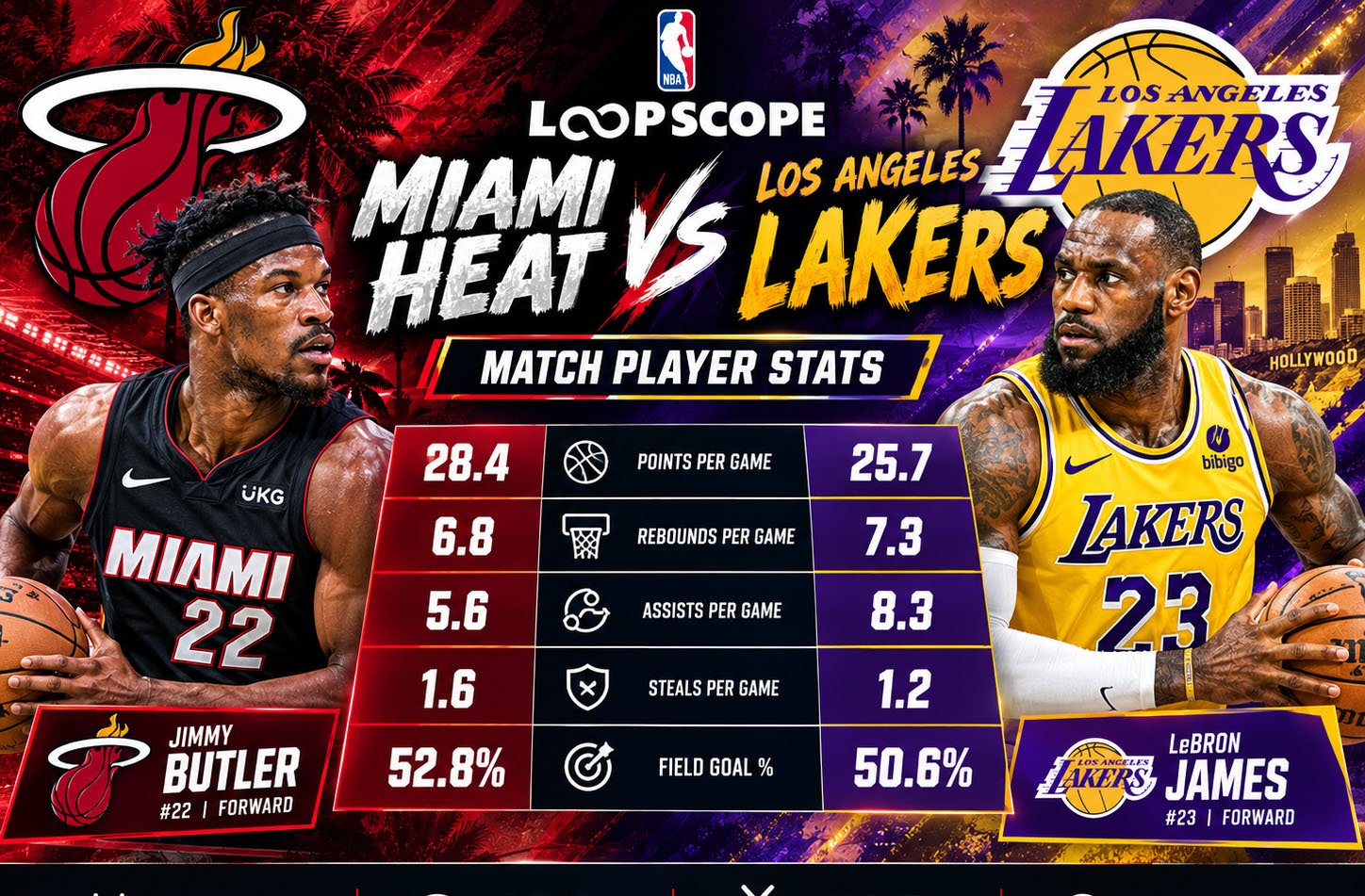
When fans search for Miami Heat vs Lakers match player stats, they usually want one of two things: the box score from a specific game, or a clear way to tell who actually played well. This guide handles both. It explains how to read every column in a Heat and Lakers box score, which players tend to shape the result, and what the numbers reveal about how these two franchises play.
Every game produces its own stat line, so this article does not claim figures from one particular night. It gives you a reliable method you can apply to any Heat vs Lakers game, plus the history and context that make the numbers easier to interpret.
What Miami Heat vs Lakers Match Player Stats Actually Tell You
Player stats are a record of what each athlete did while on the floor: how many points they scored, how efficiently they shot, how many rebounds and assists they collected, and how often they gave the ball away. A box score puts those numbers side by side for both teams, which makes it the starting point for almost every recap and betting analysis.
The catch is that raw numbers can mislead. A player with 30 points on 32 shots had a very different night than a player with 30 points on 19 shots. That is why a good reading of Heat vs Lakers player stats looks at volume, efficiency, and impact together.
Quick Answer: How to Read a Heat vs Lakers Box Score
Start with minutes played, then look at points, rebounds, and assists. Next, check shooting efficiency (field goal, three-point, and free throw percentages) and turnovers. Finish with plus/minus, which shows how the team performed with that player on the court. Reading in this order gives you a fast and fair picture of who helped most.
Background: A Rivalry Built on Finals and Star Power
Heat vs Lakers does not carry the long history of Lakers vs Celtics, but it has produced some of the most memorable basketball of the past two decades. Both franchises have won multiple championships, and both have been built around stars who changed how the league talked about team building.
The 2020 NBA Finals
The best-known chapter is the 2020 NBA Finals, played in the league’s Florida bubble. The Lakers won the series four games to two, finishing it on October 11, 2020. LeBron James was named Finals MVP. Miami, a lower seed that season, pushed the series further than many expected, and Jimmy Butler put up triple-doubles in two of Miami’s wins, including a 40-point performance in Game 3.
That series is a useful reference point for readers because it shows how player stats and results can tell different stories. Miami’s star players posted huge individual numbers, yet the Lakers’ depth and defensive size won out over six games.
Why the Matchup Still Draws Attention
Even outside the postseason, Heat vs Lakers is a game people watch closely. Miami is known for its disciplined, defense-first identity under head coach Erik Spoelstra, while the Lakers have long relied on high-profile offensive talent. Contrasting styles tend to create interesting stat lines, because each team pushes the other out of its comfort zone.
Full Box Score Breakdown: What Each Column Means
Before comparing players, it helps to know exactly what each column measures. The table below covers the standard numbers you will see in any NBA box score from a Heat and Lakers game.
| Stat | What It Measures | Why It Matters in This Matchup |
|---|---|---|
| MIN | Minutes played | Shows how much the coach trusted a player in that game |
| PTS | Points scored | Shows scoring output, but not efficiency |
| REB | Total rebounds | Reveals who controlled the glass and second chances |
| AST | Assists | Shows playmaking and ball movement |
| STL | Steals | Indicates active hands and defensive pressure |
| BLK | Blocks | Indicates rim protection |
| TO | Turnovers | Shows ball security under pressure |
| FG% | Field goal percentage | Measures shooting efficiency from the floor |
| 3P% | Three-point percentage | Matters when either team goes on a shooting run |
| FT% | Free throw percentage | Shows reliability in close games |
| +/- | Plus/minus | Shows team scoring margin while the player was on court |
A Few Reading Tips
Minutes deserve more attention than most fans give them. A bench player who scores 14 points in 18 minutes may have helped more than a starter who scored 18 in 36 minutes. Likewise, a negative plus/minus does not always mean a player performed badly. It can reflect the quality of the lineup around him, or a hot streak by the other team that happened to occur while he was in the game.
Top Performers: Who to Watch on Each Side
Rosters change every season, so always confirm the current lineups before drawing conclusions. That said, several players have defined how these two teams are viewed, and knowing their roles makes the box score easier to interpret.
Miami Heat
Bam Adebayo is the player most often at the center of Miami’s stat sheet. He anchors the defense, rebounds well, and can run the offense from the elbow. When you read a Heat box score, his rebounds, assists, and defensive numbers often tell you more than his point total.
Tyler Herro is typically the team’s primary perimeter scorer. Because he takes a lot of shots from long range and off the dribble, his efficiency swings from game to game. A strong night from him usually shows up in three-point makes and free throw attempts.
Miami also tends to spread production across several players, so do not be surprised when the Heat’s top scorer is not a household name. That balance is part of the team’s identity.
Los Angeles Lakers
Luka Doncic is the Lakers’ central offensive engine. His stat lines often involve points, rebounds, and assists in the same game, which is why triple-double chances come up so often when he plays. He also handles a high share of the team’s possessions, so his turnovers deserve a look too.
LeBron James remains one of the most closely watched players in any game he appears in, and his assists and shooting efficiency often reveal how the Lakers’ offense is flowing. Austin Reaves is another name to track, since his scoring and playmaking can swing a game when the primary stars are being guarded tightly.
Keep in mind that availability matters. Injuries, rest days, and trades can change who actually appears in a given game, so check the official lineup before assuming anything.
Players to Watch at a Glance
| Team | Player | Role | Stat Lines Worth Checking |
|---|---|---|---|
| Heat | Bam Adebayo | Defensive anchor and facilitator | Rebounds, assists, blocks |
| Heat | Tyler Herro | Perimeter scorer | Three-point makes, free throws |
| Lakers | Luka Doncic | Primary playmaker | Points, assists, turnovers |
| Lakers | LeBron James | Veteran creator | Assists, shooting percentage |
| Lakers | Austin Reaves | Secondary creator and scorer | Points, free throw attempts |
Advanced Stats That Explain the Real Story
Traditional box score numbers only go so far. Advanced metrics add context, and many are available on the NBA’s official stats pages and team apps shortly after a game ends.
True shooting percentage combines two-point, three-point, and free throw shooting into one efficiency number. It is a better measure of scoring quality than field goal percentage alone, because it credits players who earn free throws and hit threes.
Usage rate estimates the share of team possessions a player finishes with a shot, a free throw trip, or a turnover. A high usage player on a poor shooting night can drag down a team’s offense, which is why this number pairs well with efficiency.
Offensive and defensive rating estimate how many points a team scores or allows per 100 possessions. Looking at these for individual lineups can show why a particular five-man group helped or hurt the Heat or Lakers in a specific stretch.
You do not need to memorize formulas. The practical takeaway is simple: when a player’s points look impressive, check how many shots it took to get them.
How Team Style Shapes Player Stats
Stat lines do not exist in a vacuum. They are shaped by the way each team plays.
Miami has built its reputation on defensive versatility, pressure, and a willingness to mix coverages, including zone looks that many teams avoid. This can push opponents into difficult shots late in the clock, which tends to lower shooting percentages for the other side. Miami’s own players often record steals and deflections that never appear in point totals but influence the result.
The Lakers, on the other hand, usually rely on star creation and size. They can score in the paint, draw fouls, and punish mismatches. When their stars are efficient, their stat lines look dominant. When opponents load up on those stars, secondary scorers need to step in.
When these two approaches meet, you often see a tug of war between Miami’s disciplined defense and the Lakers’ individual talent. Reading the box score with that tension in mind helps you understand why a player had a quiet night or a big one.
How to Judge Top Performers Beyond Points
Picking a “player of the game” sounds easy, but it deserves more thought than looking at the highest scorer.
Start with efficiency. A player who scores 28 on strong shooting and few turnovers usually deserves more credit than one who scores 32 on poor shooting with several giveaways.
Then consider the role. A center who grabs 14 rebounds and protects the rim may have had a bigger effect than a guard who scored a few extra points. Next, look at timing. Points scored in the fourth quarter of a close game carry more weight than points scored during garbage time.
Finally, check plus/minus and the flow of the game. If a player’s team was outscored badly while he was on the floor, that deserves a second look, even if his individual numbers were respectable.
Common Mistakes When Reading Player Stats
One frequent mistake is comparing players who played very different minutes. Per-minute context matters, especially for bench players.
Another is treating a single game as proof of a trend. NBA players have hot and cold nights, and one big performance against the Heat or Lakers does not define a season.
Fans also sometimes overlook defensive impact. Steals and blocks capture only part of it. A player who forces tough shots without recording a single defensive stat can still change a game.
Finally, be careful about the source. Early stat lines can be corrected after a game, and unofficial sites sometimes lag behind. For accuracy, rely on official NBA stats and team channels, and double-check numbers before publishing or betting based on them.
Where to Check Official Heat vs Lakers Player Stats
The most dependable source for official player stats is the NBA’s own website and app, where box scores, shot charts, and advanced numbers appear soon after the final buzzer. Both the Miami Heat and Los Angeles Lakers also publish game recaps and stat summaries through their team websites and social channels. If you plan to cite specific numbers in an article, compare at least two official sources first to avoid errors.
Key Takeaways from Heat vs Lakers Matchups
A few patterns hold up across this matchup, regardless of the specific game.
Miami’s strength is collective effort. The team often wins when its role players hit open shots and its defense forces tough possessions, even if no single player dominates the scoring column.
The Lakers’ strength is high-end creation. When their primary stars shoot efficiently and avoid turnovers, the offense can be difficult to stop.
Rebounding and turnovers frequently decide close games between these teams. Extra possessions are valuable against a defense as organized as Miami’s, and against an offense as talented as Los Angeles’.
Finally, the best way to judge a performance is to combine the traditional box score with efficiency and impact metrics instead of relying on any single number.
Conclusion
Understanding Miami Heat vs Lakers match player stats comes down to reading the numbers in context. Points, rebounds, and assists tell you what happened, while shooting efficiency, turnovers, minutes, and plus/minus tell you how much it mattered. Add the background of the 2020 Finals and the contrasting styles of the two franchises, and a box score becomes a story rather than a spreadsheet.
Whenever a new Heat and Lakers game finishes, use the framework above: check minutes first, compare efficiency, look at the roles each player filled, and confirm the figures with official sources. That approach will help you identify the true top performers and explain why the game turned out the way it did.
Frequently Asked Questions
Who had the best stats in the Miami Heat vs Lakers game?
The answer depends on the specific game. Check the official box score and compare points, rebounds, assists, and shooting efficiency to find the top performer.
Where can I find official Heat vs Lakers player stats?
The NBA website and app publish official box scores right after games. The Heat and Lakers team sites also share recaps and stat summaries.
What does plus/minus mean in a box score?
Plus/minus shows how much a team outscored or was outscored by its opponent while a player was on the court. A positive number means the team did better with him playing.
Which players are most important on the Heat and Lakers?
Bam Adebayo and Tyler Herro are central to Miami, while Luka Doncic, LeBron James, and Austin Reaves are key names for the Lakers. Always confirm current rosters and injury reports.
Who won the 2020 NBA Finals between the Heat and Lakers?
The Lakers won the series four games to two. LeBron James was named Finals MVP.
Is points scored the best way to judge a player’s performance?
No. Efficiency, rebounds, assists, turnovers, and defensive impact give a fuller picture than points alone.
Why do box scores sometimes change after a game?
Stat crews can review and correct plays after the game ends. Small adjustments to assists, rebounds, or steals are common, so check official sources for final numbers.