 Caleb Whitaker
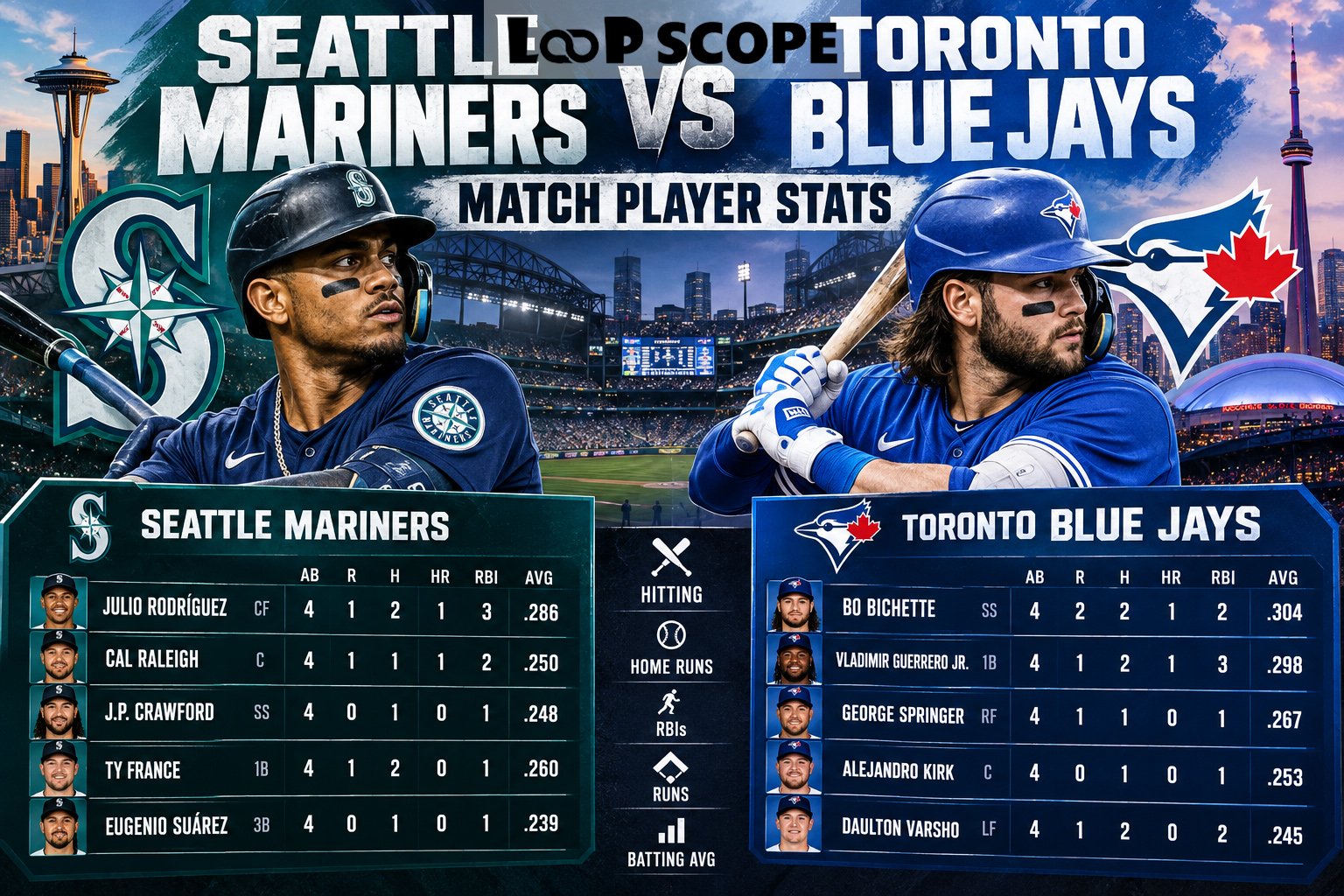
If you are searching for Seattle Mariners vs Toronto Blue Jays match player stats, the most important box score in this rivalry is Game 7 of the 2025 American League Championship Series. On October 20, 2025, the Blue Jays beat the Mariners 4-3 at Rogers Centre, and George Springer decided it with a three-run home run in the seventh inning. Toronto won its first pennant since 1993, and Seattle remained the only MLB club that has never reached a World Series.
That game gives fans more to study than most regular-season series ever will. Julio Rodriguez homered, Cal Raleigh homered, Kevin Gausman worked a scoreless inning in relief, and Jeff Hoffman struck out the side in the ninth. This guide breaks down those stat lines, shows how the game turned, and explains how to read a baseball box score when these two clubs meet again.
Quick Answer: Who Had the Best Stats in Mariners vs Blue Jays?
Springer owned the biggest swing. His three-run homer off Eduard Bazardo, a 381-foot drive to left field, turned a 3-1 deficit into a 4-3 lead, and it was his fourth home run of that postseason. Rodriguez had the best game for Seattle, with a leadoff double in the first inning and a leadoff home run in the third. Raleigh added a solo shot in the fifth, which came off Louis Varland. For Toronto, Gausman earned the win with a scoreless seventh, Chris Bassitt pitched a perfect eighth, and Hoffman closed it out with three strikeouts. Vladimir Guerrero Jr. was named ALCS MVP for the series.
The Game 7 Box Score at a Glance
The crowd at Rogers Centre was a sellout of 44,770. Seattle led 1-0 after one inning, Toronto tied it in the bottom half, and the Mariners went ahead 2-1 and then 3-1 before the seventh inning broke the game open. The first table shows the main individual lines from the box score.
| Player | Team | Key Numbers |
|---|---|---|
| George Springer | Blue Jays | 3-run HR in the 7th, 381 feet |
| Julio Rodriguez | Mariners | Leadoff double in the 1st, leadoff HR in the 3rd |
| Cal Raleigh | Mariners | Solo HR in the 5th |
| Daulton Varsho | Blue Jays | RBI single in the 1st, tied game 1-1 |
| George Kirby | Mariners | 4 IP, 1 R, 4 H, 1 BB, 3 K |
| Shane Bieber | Blue Jays | 3.2 IP, 2 R, 7 H, 1 BB, 5 K |
| Kevin Gausman | Blue Jays | Win, scoreless 7th, 3 walks |
| Jeff Hoffman | Blue Jays | 3 strikeouts in the 9th, second save of the postseason |
Notice how little the starting pitchers matter to the final result. Kirby allowed one run and Bieber allowed two, yet neither earned the decision. In a game this tight, the box score shifts from starters to the bullpen by the middle innings, and the relievers’ lines carry the story.
How Game 7 Unfolded Inning by Inning
Rodriguez opened the game with a double, and Josh Naylor singled him home with one out. Naylor was then ruled out for interference on a double-play relay, which ended the inning and kept the lead at 1-0. Toronto answered in the bottom half when Varsho singled off Kirby to tie the game.
Rodriguez led off the third inning with a home run to put Seattle ahead 2-1. Raleigh did the same thing in the fifth, hitting a leadoff homer off Varland for a 3-1 lead. Raleigh led the majors with 60 regular-season home runs, so that swing carried the weight of his whole season.
Then came the seventh. Addison Barger walked, Isiah Kiner-Falefa singled, and Andres Gimenez moved both runners up with a sacrifice bunt. Seattle pulled starter Bryan Woo, and Springer then hit a three-run home run to left field. It was the first go-ahead homer in Game 7 history by a team trailing by multiple runs in the seventh inning or later, according to the postgame coverage.
| Inning | Team | Event |
|---|---|---|
| 1st | Mariners | Rodriguez double, Naylor RBI single, 1-0 |
| 1st (bottom) | Blue Jays | Varsho RBI single, 1-1 |
| 3rd | Mariners | Rodriguez leadoff HR, 2-1 |
| 5th | Mariners | Raleigh leadoff HR, 3-1 |
| 7th | Blue Jays | Springer 3-run HR, 4-3 |
Player-by-Player Takeaways
George Springer
Springer’s homer was his 23rd career postseason home run, which tied Kyle Schwarber for third place on the all-time list. Manny Ramirez holds the record with 29. Numbers like that matter because they put one swing in context. A veteran who hits the biggest home run of the series is a reminder that experience shows up in October box scores.
Julio Rodriguez and Cal Raleigh
Rodriguez doubled and scored in the first inning and homered in the third, so he scored two of Seattle’s three runs. Raleigh’s homer supplied the third. Together they crossed the plate for every Mariners run, and that is also the problem: when two players supply the whole offense, one bad inning from the bullpen can decide the game. Seattle lost a 3-1 lead in the seventh, and it was the club’s first postseason Game 7.
The Toronto Bullpen
Toronto used Bieber for 3.2 innings, then turned to a string of relievers. Gausman, a starter by trade, made his first relief appearance since the 2021 playoffs and escaped the seventh without allowing a run despite three walks. Bassitt followed with a perfect eighth, and Hoffman struck out all three batters in the ninth. That sequence is the standard model for a modern postseason pitching plan: starters go as long as they are effective, and a deep bench of arms covers the rest.
What the Box Score Teaches You
The first lesson is about leverage. A walk in the first inning and a walk in the seventh inning look identical in the column, yet the seventh-inning walks to Barger and the single by Kiner-Falefa set up the game’s biggest play. When you read a baseball box score, give extra weight to events that put runners on base in late innings.
The second lesson is about the bunt. Gimenez’s sacrifice bunt does not appear in a batting average, but it moved two runners into scoring position and forced Seattle’s hand with the pitching change. Small plays like that often explain a result better than the leaders’ lines do.
The third lesson is about the umpire’s call in the first inning. Naylor’s single scored a run, and then he was ruled out for interference on the relay, which erased what could have been a bigger inning for Seattle. Pitch and play detail from a play-by-play source tells you more than the line score can.
The Rest of the Series
Toronto lost the first two games at home and then won four straight, becoming the fourth team to come back from that deficit in a best-of-seven postseason series. Game 1 at Rogers Centre on October 12 went to Seattle 3-1. Game 3 at T-Mobile Park on October 15 went to Toronto 13-4. The swing from a low-scoring opener to a 13-run game shows how volatile a single baseball box score can be, and why one game never tells you the whole story of a rivalry.
Guerrero was the series MVP, which fits the pattern: the player who produces steadily over seven games often earns the award even when a teammate hits the most famous home run. If you are comparing players across the series, look at on-base percentage, extra-base hits, and runs batted in, not just the Game 7 headline.
How Both Clubs Look Going Forward
Toronto has a core built around Guerrero, Springer, Varsho, and a rotation and bullpen that proved deep in October. Seattle has Rodriguez, Raleigh, Kirby, and Woo, and the pitching staff remains among the better groups in the league. Rosters change every winter, so verify current lineups on the official MLB site before using last October’s numbers to project a new matchup. Any 2026 games between the clubs should also be checked on the official schedule, because this guide uses the 2025 postseason as its anchor.
Baseball Box Score Column Guide
Baseball box scores use shorthand that confuses new readers. AB means at-bats, H means hits, R means runs, and RBI means runs batted in. BB is walks and K is strikeouts. For pitchers, IP is innings pitched, with the decimal showing thirds of an inning, so 3.2 means three and two-thirds. ER means earned runs, and pitches thrown tells you how hard a starter worked. Reading a line like Bieber’s 3.2 IP, 2 R, 7 H, 5 K tells you he struggled with contact but missed bats. Reading Kirby’s 4 IP, 1 R tells you he was effective but did not go deep enough to protect the lead.
Key Players to Watch in the Next Meeting
For Toronto, watch Guerrero’s on-base percentage and extra-base hits, Springer’s leadoff production, and Varsho’s contact. On the mound, track Gausman’s walks, Bassitt’s strikeouts, and Hoffman’s save opportunities. For Seattle, watch Rodriguez’s leadoff at-bats, Raleigh’s home runs and strikeout rate, and Naylor’s run production. Kirby and Woo are the starters whose innings pitched will tell you whether the bullpen is taxed. Check the active roster on game day because injuries and call-ups change the lineup quickly.
How to Pick the Real Top Performer
Start with run impact, then leverage, then role. Rodriguez produced two of Seattle’s runs, but Springer produced the lead-changing three-run homer in the highest-leverage inning of the game. A reliever who throws one scoreless inning with the game on the line, like Gausman, may be more valuable than a starter who throws five innings in a blowout. And a perfect ninth inning to close out a pennant carries a different weight than a perfect ninth in April.
Common Mistakes When Reading Mariners vs Blue Jays Stats
The first mistake is ignoring the bullpen. Seven games of starter-only statistics miss most of what decided this series. The second is treating a home run total as the whole offensive story, since walks, bunts, and baserunning created the seventh-inning rally. Third, many fans quote the series score without noting that Toronto trailed 0-2. Fourth, remember that single-game lines can be changed after official scoring reviews, so confirm exact figures on the league’s own box score page.
Conclusion
Reading Seattle Mariners vs Toronto Blue Jays match player stats well means looking past the final score of 4-3 and focusing on the inning that decided it. Springer’s three-run homer, Gausman’s escape, Bassitt’s perfect eighth, and Hoffman’s strikeouts gave Toronto the pennant, while Rodriguez and Raleigh gave Seattle a lead it could not hold.
The next time these clubs meet, check the starting pitchers first, then the bullpen usage, then the late-inning at-bats. That order will tell you whether Game 7 was a template or a one-night swing of fortune.
Frequently Asked Questions
Who won Game 7 of the Mariners vs Blue Jays ALCS?
Toronto won 4-3 on October 20, 2025, at Rogers Centre.
Who hit the game-winning home run?
George Springer hit a three-run homer in the seventh inning off Eduard Bazardo.
Who was the ALCS MVP?
Vladimir Guerrero Jr. was named MVP of the series.
Who earned the win and the save?
Kevin Gausman was the winning pitcher, and Jeff Hoffman earned the save.
What was the series score and result?
Toronto won the series 4-3 after losing the first two games, and the Blue Jays advanced to the World Series.
Did Cal Raleigh and Julio Rodriguez homer in Game 7?
Yes. Rodriguez hit a leadoff home run in the third inning, and Raleigh hit a leadoff homer in the fifth.
Where can I find official Mariners vs Blue Jays player stats?
MLB.com and Baseball Reference publish official box scores and play-by-play for every postseason game.